
Imagining the Next Century of Storytelling
If you transported a devoted reader from the year 1926 into a bookstore today, you would probably have to give them a moment to recover. E-readers. Audiobooks streaming from tiny wireless devices. International authors available instantly. Fans discussing plot twists in online communities. A million books at your fingertips, and more coming every week.
And yet, despite all of this, they would still recognize something deeply familiar. Readers still curl up with stories at night. Still get attached to characters. Still lend books to friends with the same tender warning: Please give it back.
Books change, but reading doesn’t die. It adapts.
Now imagine the same leap forward, but from today to 2126.
What might reading look like in a hundred years? Will we still flip paper pages? Will authors share story space with artificial intelligence? Will readers experience novels the way we experience cinema today?
The truth is, no one can predict the future with perfect accuracy. But if you look closely at how technology, psychology, and culture are moving today, the next century of reading begins to take shape. And it’s not dystopian, nor is it mechanical or soulless. In fact, the future of books might be more human, more imaginative, and more emotionally resonant than ever before.
As always here at New Books Alert, let’s explore what’s coming.
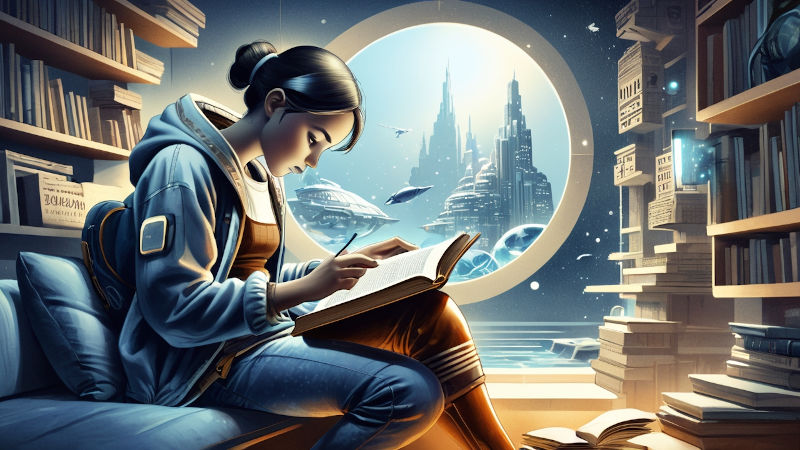
1. Stories That Adapt to the Reader – Without Losing Their Soul
The idea of a book that changes as you read it sounds like something out of speculative fiction, but the seeds already exist today. Algorithms personalize everything from playlists to newsfeeds. Video games adjust difficulty on the fly. Even reading apps track speed and comprehension to tailor recommendations.
But the adaptive book of 2126 won’t just recommend what to read next; it will gently shape the story you’re reading right now.
How Adaptive Fiction Might Work
Picture a novel built with multiple narrative paths, all written by the author, but governed by an engine that detects how you engage:
- linger on character-driven moments → the story leans more emotional
- skim long descriptions → the world-building becomes more concise
- love political intrigue → side characters gain more strategic roles
- prefer romance → relationship arcs deepen subtly
This isn’t a “choose your own adventure” with clunky branches. It’s more like narrative jazz: the author sets the melody, the structure, the emotional arc—but the rhythm adjusts to each reader’s natural sensibilities.
Will This Undermine Authorial Intent?
Exactly the opposite.
Authors will design the story like a sculptor designs a statue with multiple possible perspectives. The core message stays the same. The creative heart remains intact. But readers get a version that feels eerily attuned to them, not because the story panders, but because it responds.
Ethical Designing for Emotion
A century from now, psychological literacy will be woven into writing tools. Not to manipulate readers, but to ensure healthy interaction.
A book won’t overwhelm sensitive readers with trauma-heavy material without giving them options. It won’t let anxious readers get stuck in spirals. It may suggest breaks, offer grounding passages, or provide optional summaries.
Imagine a thriller that can reduce intensity slightly if you’re reading alone at night, or a grief-driven literary novel that offers reflective commentary if the emotional load becomes heavy.
The result? Stories that feel personal, but still authored; the perfect marriage of human creativity and adaptive design.

2. Hyper-Real Audiobooks and the Evolution of Listening
Audiobooks are already the fastest-growing format today. But what’s coming next makes even the most cinematic productions seem quaint.
The Era of Holo-Audio
In 2126, sound isn’t simply heard; it’s inhabited.
Listeners will experience:
3D spatial narration
Voices that shift naturally in space without ever distracting from the story’s emotional core. If two characters whisper in a dark hallway, you’ll feel the depth of the hall, the echo of their steps, the closeness of their breaths; not because the audiobook is showing off, but because it’s serving the narrative.
Adaptive performance
AI-assisted tools will allow narrators (human or hybrid) to subtly adjust:
- pacing
- emotional tone
- emphasis
- character voice variation
If you’re walking briskly outside, the narration might increase tempo just slightly. If you pause the audiobook mid-sentence, it will know to repeat the last line gently when you return.
Emotionally intelligent narration
You put the book down during a devastating chapter? When you return, the audiobook may offer a soft re-entry line such as:
“Welcome back. When you’re ready, we’ll continue.”
No spoilers. No interruption. Just humane design.
3. Multisensory Reading – Done Thoughtfully, Not Gimmicky
There’s a version of this future where reading turns into a theme park attraction. That’s not the version that will win.
Readers don’t want their novels to explode with flashing lights and scents. They want immersion that supports storytelling, not distracts from it.
So future multisensory reading will be subtle and opt-in.
Examples of Gentle Enhancements
- When a character arrives in a cold northern landscape, the margins of your device may shift to cool-toned hues.
- During a romantic scene, background ambiance may soften the lighting around the screen.
- When reading science fiction, diagrams could softly animate only when tapped.
- When reading fantasy, ancient symbols could shimmer faintly when relevant.
Optional. Minimal. Artful.
Accessibility Benefits
For neurodivergent readers, these cues can improve comprehension.
For visually impaired readers, tactile vibrations could aid navigation.
For language learners, contextual hints could clarify meaning.
Multisensory books won’t be theme parks; they’ll be empathetic tools.
4. Books That Continue After Publication: Literary Worlds That Evolve
We’re already seeing early signs of this:
- authors releasing deleted scenes
- interactive maps
- bonus novellas
- newsletters expanding lore
- serialized fiction platforms
By 2126, this becomes something richer: a living worldstream attached to every major book.
How Worldstreams Work
When you finish a novel you adore, you can opt into receiving occasional expansions:
- character diaries
- author commentary
- historical notes
- alternative endings
- epilogues released years later
- prequel fragments
- side-character adventures
This doesn’t replace the book. It extends its life in your imagination.
Why This Matters Psychologically
Books today end abruptly. You close the back cover and face withdrawal. In the future, stories can taper off naturally, offering gentle closure or optional ongoing connection.
For huge worlds (fantasy, sci-fi, historical epics), this creates literary ecosystems that feel as rich as the fictional universes in film and gaming, but rooted in prose.
Authors remain the architects. Readers become long-term residents.

5. The Rebirth of Physical Books; More Artisan, More Personal, More Revered
Every time technology evolves, something analog becomes more beloved. Vinyl. Film cameras. Handmade crafts. The same will happen, already is happening, to books.
By 2126, printed books will be more beautiful, more varied, and more intentional.
Why Physical Books Will Survive (and Thrive)
Humans crave tactility. Screens fatigue us. Digital overload pushes us back to objects with weight and texture.
Reading a physical book is a ritual. And rituals endure.
Future Print Innovations
1. Pressure-sensitive annotations
Tap a corner, and footnotes appear like faint ghost text—there when you want them, gone when you don’t.
2. Enhanced materials
- eco-silk paper
- biodegradable covers
- color-shifting inks
- geometric embossed spines
- flex-light pages that glow gently
Print becomes a luxury experience, not a cheap default.
3. Custom on-demand editions
Readers can choose:
- binding style
- cover art
- margin size
- typeface family
- thematic illustrations
Books become heirlooms, curated personally.
Books as Display Art
In a future full of invisible digital media, visible objects gain significance. Bookshelves become cultural identity markers, aesthetic choices, conversation pieces. Reading returns to being both private and proudly public.
6. Reading as a Shared Global Ritual
Today, reading is often solitary, occasionally social. Tomorrow, it becomes quietly communal.
Not in a noisy, social-media way; there’s no live-commenting on chapter three of a historical novel. But in soft, ambient ways that let readers feel connected.
The Emergence of Literary Synchrony
Imagine:
Global Reading Premieres
Just like film or television drops, a highly anticipated novel may have a global synchronized release moment. Millions of readers begin chapter one within the same 24-hour window. A worldwide hush descends.
Synchronized Reading Mode
If you choose to use it, your device might show you:
“You and 56,204 other readers paused here today.”
No spoilers. No chatter. Just a quiet awareness that the story is echoing around the planet.
Reading Rooms Without Walls
People can join “silent clubs,” where everyone reads the same book at the same time, no sound or text chat – just a feeling of companionship.
Why This Matters Emotionally
Humans crave belonging. But readers also crave solitude.
This future gives both: individual immersion with soft social resonance.
7. AI Co-Authors, Creative Tools, and the Future of Authorship
Few literary topics generate as much debate today as the role of artificial intelligence in writing. But fast-forward a century, and the question won’t be, “Will AI replace authors?” Instead, it will be:
“How will authors shape AI to amplify human creativity?”
Despite fears, the future of writing is not an authorless void; it’s a creative renaissance where tools evolve, but the storyteller remains unmistakably human.
Writers Become Creative Directors, Not Replaced Workers
In 2126, an author may work with what’s essentially a narrative studio assistant:
Worldbuilding Assistants
Imagine crafting a fantasy world. Instead of manually calculating medieval rainfall patterns or constructing an elvish linguistic family tree, a writer can ask:
“Generate three possible river systems based on these mountains.”
The AI offers options. But the author chooses, edits, discards, reshapes.
The author curates, the author directs, the author invents the heart.
Micro-draft Simulation
Before writing a chapter, an author might simulate emotional outcomes:
- Does increasing tension in chapter nine weaken chapter twelve’s resolution?
- Does adding a mentor character strengthen the protagonist’s motivation?
- Does cutting a subplot improve pacing?
This isn’t “cheating”; it’s story architecture.
Emotional Intelligence and Ethical Writing
Future tools may help authors avoid problematic tropes, cultural missteps, or harmful stereotypes by offering thoughtful flags or alternative framings.
- Not censoring.
- Not policing.
- Not perfect
- Just providing context.
Authors still choose what matters most to the story’s themes.
Creative Transparency Becomes Standard
Books in 2126 might include a small page titled:
CREATIVE PROCESS NOTES
This novel was written by [Author Name], with AI assistance in:
– cosmology mapping
– historical detail smoothing
– naming conventions for minor characters
This isn’t required. It’s just expected; like film credits.
Readers won’t be scandalized by AI involvement. They’ll appreciate clarity.
In fact, future readers will still seek books written by human beings because human perspective; messy, flawed, hopeful—is irreplaceable.
AI will help paint the backdrop.
But the human will write the light.
8. Reading Beyond Screens; A Return to Natural Interaction
Screens dominate the present, but the future of reading may actually move away from glowing rectangles altogether. Not because screens fail, but because humans crave comfort and biological ease.
In 2126, new mediums might make digital reading feel more like paper; gentle, soft, physical.
Text That Appears on Surfaces, Not Screens
Imagine sitting in bed and having your nightstand softly project a page of your book in crisp, floating text. Not a blinding digital glare – something like ambient ink-light, easy on the eyes.
Or imagine reading outdoors with text that adapts perfectly to sunlight, using micro-particles that bend light without glowing.
These aren’t screens. They’re light fields – text suspended in perception.
Digital Paper You Can Fold
Future e-paper could feel like a thin sheet of soft plastic that folds, rolls, and bends without distortion. You can bookmark it physically. You can hand it to someone. You can hold it like a paperback.
Except it updates itself, storing thousands of books.
Tactile, Sensory-Aware Reading
Your reading surface may respond to your touch or to environmental cues:
- dimming when the room darkens
- adjusting line spacing based on fatigue
- offering tactile guidance for visually impaired readers
- shifting font shape subtly to prevent eye strain
This is reading not as technology, but as comfort; technology dissolving into experience.
9. Personalized Libraries; Your Reading Life as a Living Archive
One of the most transformative ideas for reading’s future is the personal library that grows, learns, and evolves with you. By 2126, your reading history won’t be a list of titles; it will be a map of your emotional life.
Reading Memories as Life Markers
Books anchor us to who we were when we read them:
- the novel you devoured during a heartbreak
- the fantasy series that shaped your teenage years
- the essay collection that helped you choose a new career
Future reading devices could track not just what you read, but when, why, and how it affected you – privately, securely, and with your control.
Imagine being able to search your reading history like this:
- “Books that made me feel hopeful last winter.”
- “Stories I read when I moved to a new city.”
- “Characters I highlighted the most.”
Your library becomes a mirror.
AI as a Literary Companion, Not a Gatekeeper
Your reading companion might say:
“You’ve been enjoying contemplative novels. Here are two uplifting ones that match your emotional pattern this month.”
Not a cold algorithm. A sensitive, reader-aware guide.
Preservation of Identity Through Books
A century from now, your personal library could become an heirloom; a digital legacy passed down, showing future generations:
- what you loved
- what shaped you
- what comforted you
- what challenged you
Books have always been our intellectual footprints. Future libraries make those footprints visible and meaningful.

10. The Universal Question: How Will Book Evolve?
After imagining adaptive stories, sensory reading, evolving worlds, artisanal print, global reading rituals, AI-assisted authorship, post-screen technology, and memory-driven libraries, a single question remains:
Will books still be significant in 2126?
The answer is not just “yes.” It’s absolutely, and perhaps more than ever.
Why Books Endure
Books survive every technological revolution because they meet profound human needs:
- empathy
- escapism
- identity
- reflection
- imagination
They don’t compete with technology – they coexist with it.
Books are not fragile. They are resilient cultural organisms.
The Paradox of Progress
The more our tools evolve, the more we seek the aspects of reading that feel timeless:
- turning a page
- meeting a character
- staying up too late
- carrying a story with us into our day
Books endure because they are not bound to format.
Print, audio, adaptive digital, tactile lightfield – these are all just vessels.
The story remains the constant.
A Future Rooted in Humanity
The future of reading isn’t about tech taking over. It’s about tech bending toward human needs.
The next century of books will bring:
- more access
- more personalization
- more empathy
- more creativity
- more community
- more imagination
Reading will become richer, more dynamic, more expressive. But it will also remain what it has always been:
A private conversation between a human mind and a human-made world.
Conclusion: Turning the Page Toward Tomorrow
A hundred years from now, books may look nothing like the bound volumes we cherish today. Or they may look almost exactly the same, but with invisible enhancements. Or they may appear in utterly new forms we haven’t yet dreamed of.
But the essence of reading – the quiet, intimate, transformative act – will endure.
Future readers will still fall in love with characters. Still gasp at plot twists. Still underline sentences that feel written just for them. Still seek comfort, adventure, wisdom, and escape in the pages of a story.
Technology will evolve. Formats will change. But the human need for narrative is eternal.
And so, in 2126, just as today, someone somewhere will curl up – however they do it then – with a story that takes them somewhere else entirely, perhaps even back to 2026..
And that moment, that magic, will still feel beautifully familiar.