

Stories That Shape How We Feel
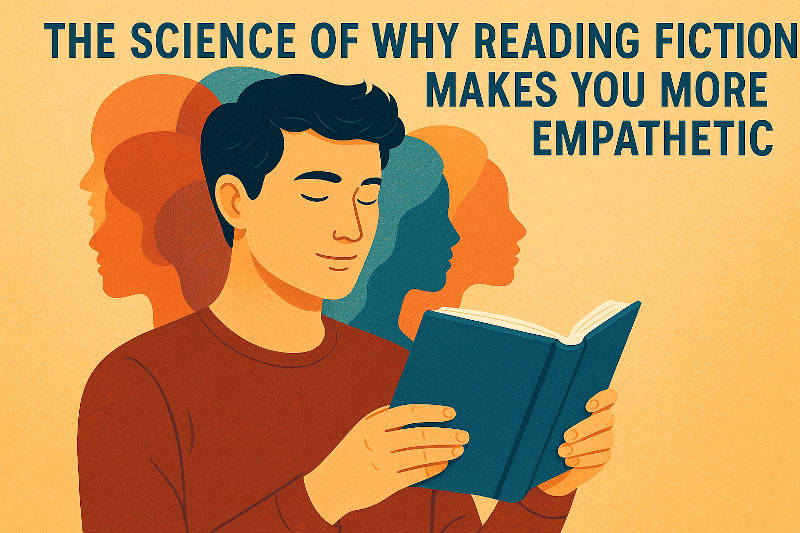
Every time you open a novel, you do something quietly extraordinary: you step into someone else’s mind. You see through their eyes, feel their fears, and walk their world. That act of mental transportation – of imagining what it’s like to be someone else – is the foundation of empathy.
Reading fiction is often dismissed as escapism, but science shows it’s much more than that. Fiction changes how we think, feel, and behave toward others. It strengthens our ability to understand complex emotions and recognize perspectives unlike our own – in short, it helps us become more human.
The Neuroscience Behind Storytelling and Empathy
Modern brain imaging has given scientists a way to peek inside the reader’s mind – and what they’ve found is stunning.
When you read about a character running through a storm, your brain’s motor cortex activates as if you were running. When that character’s heart breaks, the emotional centers in your limbic system respond, too. This process, called neural coupling, allows us to simulate the experiences of others without leaving our chair.
Neuroscientist Raymond Mar and psychologist Keith Oatley from the University of Toronto have shown that fiction acts as a social simulation. Just as flight simulators train pilots, stories train our social and emotional intelligence. They give us practice interpreting motives, decoding expressions, and predicting behavior – all skills vital for empathy and everyday relationships.
Fiction as Empathy Training
Unlike nonfiction, which delivers facts directly, fiction invites us to infer. We must read between the lines, detect sarcasm, and sense emotional undercurrents. This mental effort exercises what psychologists call the Theory of Mind – our ability to attribute thoughts and feelings to others.
When readers inhabit a character, they engage in a kind of emotional role-play. Consider reading To Kill a Mockingbird: for a few hundred pages, you see the world through Scout’s innocent curiosity, and through Atticus Finch’s quiet integrity. Or when you read The Kite Runner, you live the pain and redemption of Amir, feeling the weight of betrayal and forgiveness.
These experiences accumulate. Each story subtly widens the circle of empathy – not just for fictional people, but for real ones.
What the Research Says
The most famous study on this subject was published in Science (2013) by David Comer Kidd and Emanuele Castano. Their experiment showed that participants who read literary fiction – as opposed to popular fiction or nonfiction – scored higher on tests measuring empathy and emotional understanding.
The key lies in literary complexity. Stories with morally ambiguous characters and subtle emotions require readers to make sense of internal states – effectively giving the brain a workout in emotional reasoning.
A second 2013 study, published in PLOS ONE by M. P. Bal and Martijn Veltkamp, found that readers who felt emotionally transported into a story became more empathetic afterward. Crucially, it wasn’t just the act of reading that mattered, but how deeply one engaged with the story.
Over time, these effects compound. Long-term fiction readers tend to exhibit better social perception, richer emotional vocabularies, and stronger compassion toward marginalized groups.
The Psychology of Identification: Why We Feel What They Feel
Empathy through fiction isn’t magic – it’s psychology. When we identify with a character, our brain releases oxytocin, a hormone linked to bonding and trust. That’s why we cry when a beloved character dies, or feel a rush of pride when they overcome hardship.
Psychologists call this process emotional transportation – the sensation of being “carried away” into a narrative world. The stronger the transportation, the stronger the emotional response, and the longer it lasts after reading.
Interestingly, genre plays a role. Literary fiction often produces deeper empathetic effects because it focuses on internal lives rather than external events. But character-driven works in fantasy, romance, or even science fiction can have the same impact when they explore moral choices and personal growth.
For instance, readers who follow characters like Hermione Granger or Frodo Baggins don’t just watch a story unfold – they internalize courage, loyalty, and empathy. These emotional lessons shape real-world behavior long after the book is closed.
How Fiction Strengthens Emotional Intelligence
Empathy is the bridge between emotion and action – but emotional intelligence (EQ) is how we use that empathy wisely. Reading fiction helps develop both.
- Recognizing emotions: By decoding characters’ reactions, readers learn to read real people better.
- Perspective-taking: Fiction constantly asks, “Why did they do that?” – building cognitive empathy.
- Emotional regulation: Observing how characters handle conflict or grief helps readers model emotional control.
- Moral reflection: Fiction exposes us to ethical gray areas, allowing us to test our values safely.
Over time, these mental exercises translate into real-world social skills. That’s why educators increasingly use literature to teach empathy, leadership, and communication – from middle school classrooms to corporate workshops.
Reading in the Digital Age: Does the Medium Matter?
With audiobooks, eBooks, and social media competing for attention, some worry that deep reading is fading. But the good news is that the format doesn’t erase the benefit – what matters most is depth of engagement.
Listening to an audiobook still activates narrative comprehension and emotional centers, especially when the listener visualizes scenes vividly. However, screen-based reading often encourages skimming, which can reduce empathy-building effects.
To maximize impact, psychologists recommend slow reading – giving full focus to the story without multitasking. Immersion, not format, is what turns words into empathy.
How to Read for Empathy: Practical Tips
You can intentionally cultivate empathy through your reading habits. Here’s how to do it thoughtfully:
1. Read character-driven stories
Choose books that explore interior emotions and relationships – not just plot. Literary fiction, memoirs, and coming-of-age novels are particularly effective.
2. Diversify your bookshelf
Seek authors from different cultures, genders, and perspectives. Reading global voices helps dismantle unconscious bias and broadens emotional range.
3. Reflect as you read
Pause occasionally to imagine what a character is thinking or feeling – even those you dislike. The best empathy practice is trying to understand people you don’t agree with.
4. Discuss your reading
Talking about books helps translate internal empathy into external behavior. Book clubs and online reading communities can amplify emotional growth.
5. Balance escape and insight
It’s okay to read for entertainment – but occasionally choose books that challenge your worldview. True empathy grows in discomfort, not ease.
Why This Matters More Than Ever
In an era defined by polarization and digital distraction, reading fiction is a quiet act of resistance. It asks us to slow down, imagine others complexly, and stay open to nuance.
Social scientists warn that empathy – once considered a natural human trait – is declining, particularly among younger generations exposed to constant online conflict. Fiction offers a counterbalance. It reminds us that people are not algorithms; they are contradictions, fears, and dreams.
When you cry for a character or feel anger on their behalf, your heart rehearses compassion. And that practice carries into daily life – in how you listen, how you forgive, and how you treat strangers.
The Final Takeaway
Reading fiction is not a luxury or a hobby. It’s emotional exercise. Every page strengthens the invisible muscles that make empathy possible: imagination, curiosity, and kindness.
So the next time you pick up a novel – whether it’s a timeless classic like Pride and Prejudice or a contemporary bestseller by Celeste Ng – know that you’re not just escaping reality. You’re expanding it.
Fiction doesn’t only teach us about imaginary people; it helps us understand the real ones better. In the quiet act of reading, we rehearse what it means to be human – and that’s something the world can never have too much of.